How to Reduce Sick Days in Your Bristol Office
Cleaning vs Sanitising: What's the Difference?
Employee absenteeism is a significant hidden cost for businesses across the UK. In busy corporate environments—whether in a bustling Bristol call centre or a creative agency in Bath—colds, flu, and gastrointestinal bugs can sweep through a workforce with alarming speed.
While seasonal illnesses are inevitable, the rate at which they spread through an office is heavily influenced by the building's hygiene standards. A visually tidy office is not necessarily a hygienic one. If your business is experiencing high levels of sick leave, your current cleaning regime might be part of the problem.
Here is how upgrading your commercial cleaning strategy can actively reduce sick days and protect your workforce.
The most common mistake businesses make is confusing "cleaning" with "sanitising."
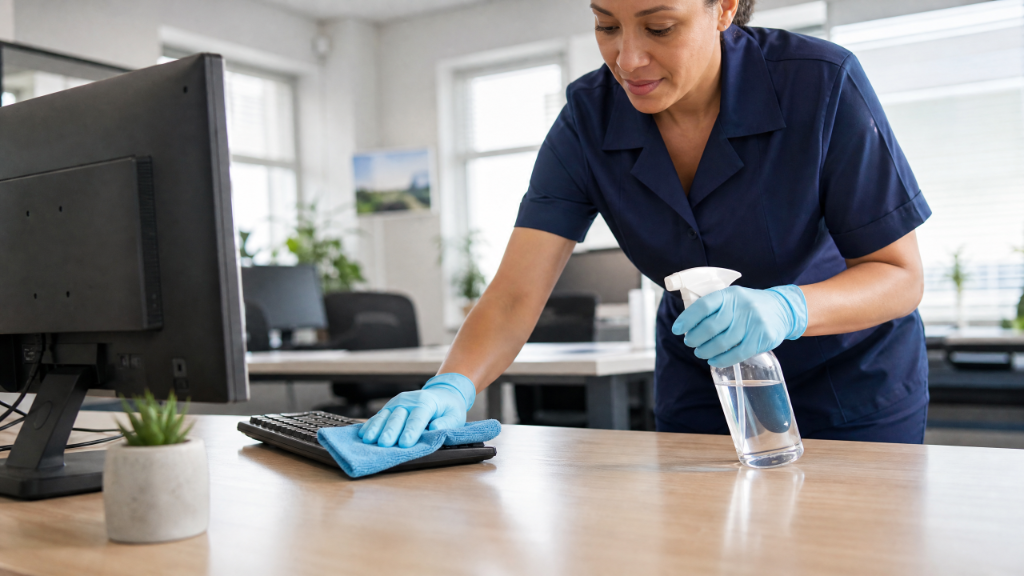
Cleaning removes visible dirt, dust, and debris. A quick vacuum and a wipe-down of a desk might make the office look pristine, but it does nothing to eliminate the microscopic pathogens that cause illness. Sanitising, on the other hand, involves using specific, chemically formulated products to kill bacteria and viruses on surfaces.
Many budget cleaning services focus purely on the visual aspect. They empty the bins, straighten the chairs, and run a vacuum over the main walkways. However, to stop the spread of illness, your cleaning team must be actively sanitising the environment using proper dwell times (leaving the chemical on the surface long enough to kill the pathogens) and correct colour-coded equipment to prevent cross-contamination.
Targeting the High-Touch Points
Viruses like the common cold, influenza, and norovirus can survive on hard surfaces for anywhere from a few hours to several days. In an office environment, the primary vectors for transmission are "high-touch points"—areas that multiple employees touch throughout the day.
If you want to reduce sick days, your cleaning contract must explicitly mandate the daily sanitisation of these critical areas:
- Door handles and push plates
- Lift buttons and stairwell handrails
- Kitchen appliances (kettle handles, microwave buttons, fridge doors)
- Shared printers and photocopiers
- Washroom taps, flushes, and dispensers
A professional commercial cleaning company will have a specific protocol for high-touch point sanitisation. At Summit Clean, our operatives are trained through the Summit Academy to identify and rigorously sanitise these transmission hotspots during every single shift.
The Danger of Cross-Contamination
One of the most alarming causes of office illness is cross-contamination introduced by the cleaners themselves. If a cleaner uses the same cloth to wipe down a washroom sink and then moves on to wipe down the kitchen counters, they are actively spreading dangerous bacteria across your premises.
To prevent this, the British Institute of Cleaning Science (BICSc) mandates a strict colour coding system. Red equipment is exclusively for washrooms, blue for general areas, green for kitchens, and yellow for clinical areas.
When auditing your current cleaning provision, check the cleaners' trolleys. If you do not see a clear, strictly enforced colour-coding system in use, your office hygiene is severely compromised.
Desk Hygiene and the "Sick Building" Syndrome
The average office desk harbours significantly more bacteria than a toilet seat. Employees eat at their desks, sneeze at their keyboards, and rarely sanitise their own workstations.
While cleaners are often instructed not to move paperwork, a professional cleaning schedule should include regular, careful sanitisation of exposed desk surfaces, shared hot-desking equipment, and meeting room tables.
Furthermore, poor indoor air quality contributes to respiratory issues and general malaise—often referred to as Sick Building Syndrome. Regular, high-filtration vacuuming (using HEPA filters) and scheduled deep carpet extractions remove the dust, allergens, and particulate matter that accumulate in commercial flooring, drastically improving the air quality your staff breathe.
Investing in a Healthier Workforce
Reducing sick days requires a proactive approach to workplace hygiene. It demands trained operatives who understand infection control, supervisors who audit the standard of sanitisation, and a transparent system that proves the critical high-touch points have actually been cleaned.
For businesses in Bristol, Cheltenham, and Gloucester, upgrading to a professional, verifiable cleaning service is an investment with a measurable return. By implementing The Summit Standard—which combines rigorous training with Xota digital verification—you can ensure your office is not just visually clean, but hygienically safe. Protecting your staff protects your productivity.
Want a healthier, more hygienic office environment? Get a free cleaning consultation from Summit Clean.
Areas We Cover
Summit Clean provides office cleaning across Bristol and the wider South West, including:
- Bristol — BS1, BS2, BS3, BS4, BS5, BS6, BS7, BS8, BS9, BS10, BS11, BS13, BS14, BS15, BS16, BS20, BS32, BS34, BS35, BS36, BS37, BS48
- Bath — BA1, BA2, BA3
- Cheltenham — GL50, GL51, GL52, GL53, GL54
- Gloucester — GL1, GL2, GL3, GL4
- Weston-super-Mare — BS22, BS23, BS24
Get in touch to discuss your requirements.

