Colour-Coded Cleaning in Healthcare: Why It Matters
Colour-Coded Cleaning in Healthcare: Why It Matters
In healthcare environments, the cloth used on a toilet must never be the cloth used on a treatment table. The system that prevents this is colour-coded cleaning — and it's not a suggestion, it's a fundamental infection control standard. For medical practices and clinics across Bristol, healthcare facility cleaning must operate to this standard without exception.
What colour-coding means
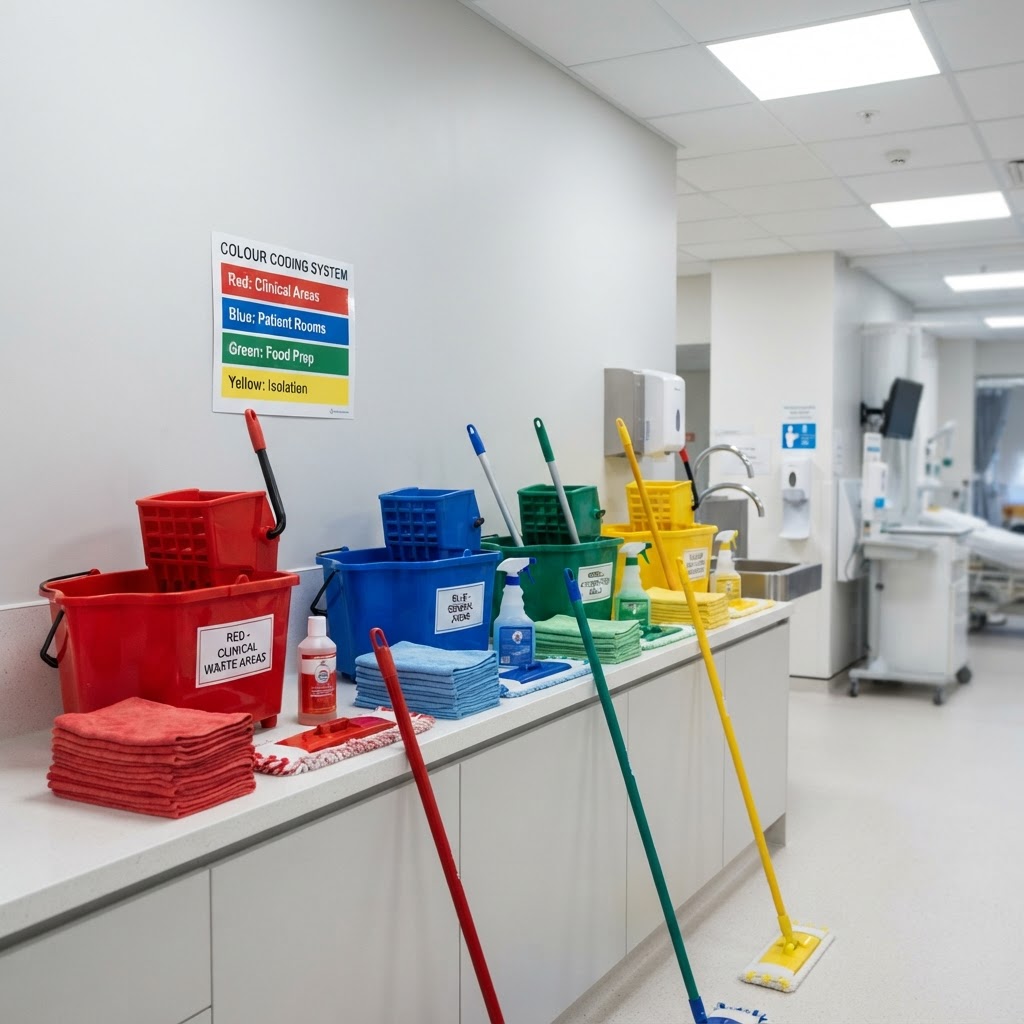
The system assigns specific colours to specific cleaning equipment — cloths, mops, buckets, and sometimes gloves — based on the area and risk level they're designated for. The standard UK colour-coding framework is:
- Red — toilets, urinals, and sanitary fixtures in washroom areas
- Blue — general low-risk areas including offices, reception, and corridors
- Green — kitchens and food preparation areas
- Yellow — isolation rooms, clinical areas, and high-risk surfaces
The principle is simple: equipment colour-matched to a zone stays in that zone. A red cloth never enters a clinical bay. A green mop head is never used in a washroom.
Why it matters in practice
Without colour-coding, the risk is invisible but serious: a cloth that has picked up bacteria from a toilet surface is then used to wipe down a treatment couch, a desk, or a door handle. The contamination is microscopic, the spread is immediate, and the consequence can be a healthcare-associated infection.
In healthcare settings, this isn't just about appearance — it's about patient safety. Vulnerable patients, post-operative recovery areas, and immunocompromised individuals are all at elevated risk from cross-contamination that proper colour-coding is designed to prevent.
What proper implementation looks like
- Full equipment segregation — cloths, mops, buckets, and handles all colour-matched, with no exceptions or "temporary" cross-use
- Clear labelling and storage — colour-coded equipment stored separately, never mixed between zones
- Single-use or properly laundered cloths — reusable cloths must be laundered at the correct temperature and returned to their designated zone
- Operative training — every cleaner must understand the system and why it matters, not just follow it mechanically
- Audit and verification — regular checks that the system is being followed, supported by digital reporting
How it fits the wider infection control programme
Colour-coding is one layer in a broader infection control strategy that includes correct contact times, hand hygiene infrastructure, waste segregation, and terminal cleaning protocols. It's the foundational layer — if the colour-coding fails, every other protocol built on top of it is compromised.
If your current cleaning provider can't clearly explain their colour-coding system, or if you've seen the same cloths used across different zones, that's a serious red flag. Talk to us about healthcare cleaning built on proper infection control foundations.
The colour-coding standards, infection control protocols and clinical-area cleaning methods described above are taught and assessed through our Summit Training Academy — ensuring every operative working in healthcare environments understands both the how and the why.
Areas We Cover
Summit Clean provides healthcare cleaning across Bristol and the wider South West, including:
- Bristol — BS1, BS2, BS3, BS4, BS5, BS6, BS7, BS8, BS9, BS10, BS11, BS13, BS14, BS15, BS16, BS20, BS32, BS34, BS35, BS36, BS37, BS48
- Bath — BA1, BA2, BA3
- Cheltenham — GL50, GL51, GL52, GL53, GL54
- Gloucester — GL1, GL2, GL3, GL4
- Weston-super-Mare — BS22, BS23, BS24
Get in touch to discuss your requirements.

